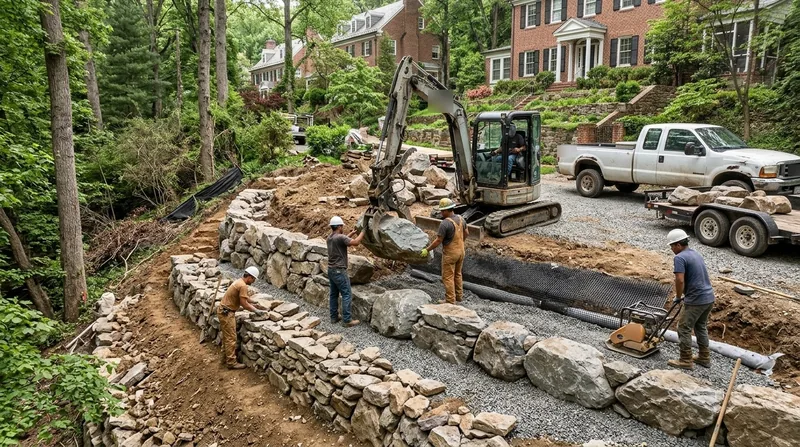




Boulder and natural stone retaining walls in Washington blend seamlessly into the wooded ravines and rocky terrain that define neighborhoods from Georgetown to the Palisades to the steep clay hillsides east of the Anacostia River. Washington's Fall Line geography, hard bedrock in the northwest and soft coastal-plain clay in the southeast, creates distinct drainage and stability challenges that fieldstone and boulder walls address with both beauty and engineering. Freeze-thaw cycles, summer cloudbursts, and the region's high water table near the rivers demand walls built with proper base preparation, gravel drainage, and stone placement that lasts decades. Whether your 1920s Colonial Revival home, Wardman porch row, or garden apartment sits on slipping clay or rocky ground, natural stone construction restores stability and character without the institutional look of concrete or block. We install, repair, and replace boulder and natural stone walls using machine-placed or hand-set fieldstone methods proven in Washington's humid, freeze-thaw climate.
Why Boulder and Natural Stone Walls Matter in Washington's Challenging Terrain
Washington's geology splits along the Fall Line, and that split drives wall failure. The northwest, with hard rock and rocky ravines around Rock Creek Park and the Palisades, sheds water quickly. The southeast, with soft coastal-plain clay under Capitol Hill, Navy Yard, and the riverside flats, holds water like a sponge. East of the Anacostia River, Hillcrest, Congress Heights, and Fort Dupont climb steep wooded hillsides of slippery, saturated clay that moves every freeze-thaw cycle and every tropical-storm downpour. Old gray fieldstone walls with mortar, brick, poured concrete, CMU, and tired landscape timbers fail here not from poor craftsmanship but from water pressure, frost heave, and clay creep. Boulder and natural stone walls, when built with modern drainage behind them, handle this climate far better than their predecessors.
- We excavate and prepare a stable, compacted base that prevents settling and frost heave on clay and rocky soils alike.
- We install perforated drain pipe and gravel backfill to move water away from the wall face, stopping the freeze-thaw damage that collapses old fieldstone.
- We set fieldstone or boulders with proper bearing and leveling so the wall sheds water and resists lateral pressure from saturated clay.
- We tie walls into the native rock or stable soil, anchoring them against the creep and slide that plague Washington's steep lots.
A well-built natural stone wall in Washington lasts 50 to 100 years, far outlasting the concrete and timber walls that fail in 15 to 30 years.
Key info: Washington building code requires a permit for retaining walls above roughly 4 feet measured from the footing, or when a wall supports a surcharge like a driveway or structure. Tall or tiered walls may require engineered drawings. Setback and property-line rules apply. Always verify thresholds with your local building department, as requirements vary by neighborhood and ward. See the District of Columbia Building Permit information for current rules in your jurisdiction.
How We Build Boulder and Natural Stone Walls in Washington: A Step-by-Step Approach
Boulder and natural stone wall construction in Washington starts with understanding your lot's drainage, clay content, and freeze-thaw history. We visit the site, assess the slope, the water flow, the soil type, and any existing failed walls or drainage problems. We then design and build a wall that sheds water, resists lateral pressure, and looks like it belongs on your property. Here is how the process unfolds from first visit to finished wall.
- We schedule a free site visit to measure the wall run, assess soil and drainage, identify permit requirements, and discuss your goals for appearance and function.
- We excavate the foundation trench to solid, undisturbed soil or bedrock, removing clay and organic matter that would settle or shift.
- We compact the base and lay a 4 to 6 inch gravel or stone foundation to distribute the weight and allow water drainage under the wall.
- We set the first course of fieldstone or boulders level and stable, using the largest stones and proper bearing to resist settling.
- We backfill behind the wall with gravel and install a perforated drain pipe that runs the length of the wall to move groundwater away from the face.
- We set successive courses of stone, stacking or fitting them to bond and shed water, filling voids with smaller stone and gravel as we build.
- We cap the wall with larger stones placed for stability and aesthetics, and grade the top to shed surface water away from the wall face.
The entire process, from excavation to final grading, takes 1 to 3 weeks depending on wall length and site access. For more detail on our approach to retaining wall installation in Washington, see our installation page.
Example: A Georgetown homeowner with a 40-foot fieldstone wall collapsing into the backyard due to clay saturation and frost heave called us in March. We excavated the failed wall, removed the clay-logged soil, installed 6 inches of compacted gravel base, set new fieldstone with proper drainage and backfill, and capped the wall with larger stones. The job took two weeks. The wall now sheds water, resists the freeze-thaw cycle, and looks like the original 1920s construction that inspired it.
| Approach | Description | Best for |
|---|---|---|
| Machine-Placed Fieldstone | Large stones set with a mini excavator or skid steer, stacked and backfilled with gravel and drain pipe. Fast, efficient, and ideal for walls 3 to 8 feet tall with good access. | Long runs on wooded lots where access allows equipment. Georgetown, Palisades, and ravine properties. |
| Hand-Set Boulder Wall | Individual boulders or large stones positioned by hand with pry bars and leverage, fitted tightly, and backfilled. Slower but allows precise placement and artistic arrangement. | Tight spaces, visible front yards, and walls where appearance is paramount. Wardman porch rows and Federal-era properties. |
| Mortared Fieldstone | Stones set in mortar joints, mimicking old gray fieldstone walls common in Washington. Provides a finished, heritage appearance and added bond strength. | Historic neighborhoods, matching existing walls, and properties where traditional aesthetics matter. Capitol Hill and Chevy Chase. |
| Dry-Stack Fieldstone | Stones fitted without mortar, relying on weight and interlocking geometry. Allows water to drain through joints and suits natural, informal settings. | Wooded ravine lots, informal gardens, and properties where a wild, natural look is desired. Rock Creek Park neighborhoods. |
Boulder and Natural Stone Walls Cost in Washington: What to Expect
Boulder and natural stone retaining wall pricing in Washington starts at approximately $25 per square foot for machine-placed fieldstone walls on accessible sites with good drainage and stable soil. That baseline assumes a wall 3 to 5 feet tall, roughly 30 to 50 feet long, with gravel base, drain pipe, and proper backfill but no special site challenges. However, several factors move the cost up, sometimes significantly. Clay-heavy lots east of the Anacostia River require deeper excavation and more extensive drainage, adding 15 to 25 percent. Tight urban lots with limited equipment access, sunken areaways, or proximity to Federal rowhouses demand hand-set work or smaller machinery, pushing cost to $35 to $45 per square foot. Mortared fieldstone adds labor and materials, typically 20 to 30 percent more than dry-stack. Tall walls, tiered walls, or walls that require engineered drawings for permit approval also increase cost and timeline.
Getting 2 to 3 estimates from licensed contractors is the smartest move. Each estimate should detail the base preparation method, drainage strategy, stone type and source, backfill material, and any permits or engineer fees included. The cheapest estimate is rarely the best value; a contractor who skips proper gravel base, drain pipe, or backfill to save $5 per square foot leaves you with a wall that fails in 10 years. For detailed pricing examples and a breakdown of what drives cost on your specific lot, visit our full pricing overview.
Boulder and Natural Stone Walls Near Me: What to Look for When Hiring a Contractor in Washington
Hiring the right contractor for boulder and natural stone walls in Washington means checking three essentials: licensing and insurance, references and past work, and understanding of local permits and terrain. Washington's freeze-thaw climate, clay-heavy soils, and strict building code requirements demand a contractor who has built walls that survive 20 winters, not one who treats every lot the same. Here is what to verify before signing a contract.
- Confirm the contractor holds a current Washington, D.C. business license and carries liability and workers compensation insurance, with certificates available on request.
- Ask for references from at least three recent boulder or natural stone wall jobs in Washington and contact those homeowners directly to ask about drainage performance and durability.
- Verify the contractor understands permit requirements for your neighborhood and is comfortable working with your local building department and any HOA restrictions on visible walls or materials.
- Request a detailed written estimate that specifies base preparation depth, drainage design, stone type, backfill material, and any permit or engineer fees, so you can compare apples to apples.
- Ask the contractor how they handle water management on your specific lot, especially if you are on clay soil or near a stream or high water table.
C. and the surrounding areas. We provide free, no-obligation estimates within 24 hours. Call us at (771) 252-1406 or contact us online to schedule a site visit and get a detailed estimate for your boulder or natural stone wall project.
Boulder & Natural Stone Walls in Washington: Pricing Guide
| Service | Price | Details |
|---|---|---|
| Machine-Placed Fieldstone Wall | Starting at $25/sq ft | Includes gravel base, drain pipe, backfill, and labor on accessible sites with stable soil and good equipment access |
| Hand-Set Boulder or Mortared Stone Wall | Starting at $35/sq ft | Higher labor cost for precise placement, mortared joints, or tight urban lots with limited equipment access or heritage constraints |
| Clay Lot or High Water Table Work | Starting at $30/sq ft | East of Anacostia River or saturated soil requires deeper excavation, extended drainage, and additional gravel backfill to prevent frost heave |
| Engineered or Tiered Walls | On estimate | Tall walls, multiple tiers, or permit-required designs need site analysis, engineer drawings, and plan review before pricing |
| Travel and Site Visit | Included | No mileage or call-out fee for free estimate within Washington, D.C. and surrounding service areas |
| Free Estimate | No charge | Response within 24 hours at (771) 252-1406, no obligation to book, detailed written quote provided |
Indicative pricing, the exact cost depends on square footage, finish, and site access. Free personalized estimate within 24h at (771) 252-1406.


