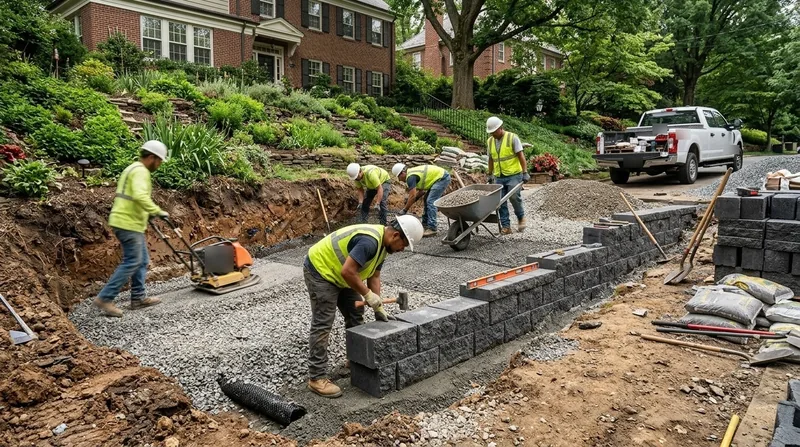




Retaining Wall Installation in Washington demands expertise in local geology, climate, and the unique architectural constraints of the city's historic rowhouse neighborhoods and steep wooded hillsides. Washington splits along the Fall Line: the Northwest rises on hard rock and rocky ravines around Rock Creek Park and the Palisades, while Capitol Hill and the riverside flats sit on soft coastal-plain sand, silt, and clay. East of the Anacostia River, neighborhoods like Hillcrest and Fort Dupont climb steep wooded hillsides of slippery clay that shifts with freeze-thaw cycles and summer cloudbursts. Federal and Victorian brick rowhouses with sunken front areaways, Wardman porch rows, and 1920s Colonial Revival homes need new walls to stabilize eroding yards, support driveways, and create level terraces. We design and build retaining walls with frost-depth footings, gravel backfill, and drainage systems engineered for the region's high water table and saturated clay soils. A properly installed wall protects your foundation, stops erosion, and adds usable space to your property for decades.
Why Retaining Wall Installation Matters in Washington's Challenging Terrain
Washington's geology and climate create constant pressure on existing walls and unprotected slopes. The freeze-thaw cycle that dominates the region's failure mode pushes soil against walls each winter, while saturated clay from tropical-storm rain and the high water table near the Anacostia and Potomac rivers destabilizes footings and drainage. Rowhouses with front areaways need walls to hold back soil and prevent basement seepage. Sloped yards in the Northwest and steep hillside lots in the East demand professional grading and wall construction to prevent slides and erosion. Without proper installation, walls lean, crack, and fail within a few years, turning a small investment into a costly replacement or emergency repair.
- We set footings below the frost line to prevent heave and shifting during winter freeze-thaw cycles.
- We install gravel backfill and perforated drainage pipe behind every wall to manage water pressure and prevent saturation.
- We grade and compact the base and backfill to match Washington's clay and silt soils and ensure long-term stability.
- We verify setback, property-line, and permitting requirements with the local building department before we break ground.
- We build walls in segmental block, poured concrete, natural stone, or timber depending on your yard, budget, and design.
A properly installed retaining wall stops erosion, protects your home's foundation, and adds years of reliable performance in Washington's demanding climate.
Key info: Washington's building code requires a permit for walls above roughly 4 feet measured from the footing, or when a wall supports a surcharge such as a driveway or structure. Engineered drawings may be required for tall or tiered walls. We handle permitting coordination with your local building department. Check the District of Columbia Department of Energy and Environment for current setback and property-line rules in your jurisdiction.
How We Install Retaining Walls in Washington: Our Process
We start every job with a site visit to assess the slope, soil type, drainage, and any nearby structures or utilities. We measure the grade difference, check the water table and runoff patterns, and discuss your design goals. Once you approve the estimate, we obtain permits if required and coordinate with the building department. We then excavate and set a frost-depth footing, build the wall to the specified height and material, and install drainage and backfill to ensure long-term stability. Our method is straightforward and proven across Washington's neighborhoods, from rowhouse areaways in Capitol Hill to terraced gardens in the Palisades.
- We conduct a free site assessment to evaluate soil, slope, drainage, and permitting requirements specific to your property.
- We provide a detailed estimate that includes material, labor, permitting, and a timeline for the work.
- We obtain all required permits and coordinate with the local building department before excavation begins.
- We excavate and prepare the footing trench to the required frost depth, typically 3 to 4 feet in Washington.
- We build the wall to spec using your chosen material (block, concrete, stone, or timber) and ensure proper batter and alignment.
- We install perforated drainage pipe behind the wall and backfill with gravel to manage water pressure and prevent saturation.
- We grade and compact the final backfill and restore the top of the slope to match your landscape or design plan.
- We perform a final inspection and walk you through maintenance and care for your new wall.
From excavation to final grading, we complete most residential retaining wall installations in Washington within 3 to 7 business days, depending on the wall height, length, and site access. For more details on how we address drainage, a critical factor in Washington's wet climate, see our page on Retaining Wall Drainage.
Example: A rowhouse owner on U Street in Washington's U Street Corridor had a sunken front areaway with crumbling fieldstone and water seeping into the basement during heavy rain. We removed the old wall, set a frost-depth footing, built a new segmental block wall with a perforated drain line, and backfilled with gravel. The areaway is now stable, dry, and designed to complement the rowhouse's historic character. Total time on site was 5 days.
Retaining Wall Installation Methods and Materials in Washington
| Approach | Description | Best for |
|---|---|---|
| Segmental Block (SRW) | Interlocking concrete blocks stacked and backfilled with gravel. Fast to install, highly stable, and designed for drainage. | Residential terraces, areaways, and slopes up to 10 feet. Most popular in Washington neighborhoods. |
| Poured Concrete | Monolithic concrete wall cast on-site with reinforcing steel and a frost-depth footing. Extremely durable and requires no ongoing maintenance. | Tall walls, high-load situations (driveways, structures), and properties where appearance is secondary to longevity. |
| Natural Stone and Boulder | Fieldstone, granite, or large boulders set on a gravel base with mortar or dry-stacked. Blends with Washington's rocky Northwest terrain and historic aesthetics. | Historic rowhouse areaways, garden walls, and properties where natural appearance matches the neighborhood character. |
| Timber (Landscape Timbers) | Pressure-treated or composite timbers stacked horizontally and anchored with rebar. Affordable and quick to install, but requires replacement in 10 to 15 years in Washington's humid climate. | Budget-conscious installations, temporary terraces, and garden edging. Not recommended for tall walls or high-water areas. |
Each material has distinct advantages in Washington's climate and soil conditions. Segmental block and poured concrete are the most durable and require minimal maintenance. Natural stone suits historic neighborhoods and steep wooded hillsides. Timber works for lower walls and informal gardens but will need replacement sooner. We recommend the material based on your site, budget, design goals, and the specific demands of Washington's freeze-thaw cycle and high water table.
Retaining Wall Installation Cost in Washington: What to Expect
Retaining wall installation costs in Washington typically start at $30 per square foot for standard segmental block walls with proper drainage and backfill. A 20-foot-long wall, 4 feet tall, runs roughly 80 square feet and costs between $2,400 and $3,200 before permitting and site preparation. Taller walls, natural stone, or poured concrete can reach $50 to $80 per square foot. The actual price depends on wall height and length, the material you choose, site access and grading complexity, whether the wall supports a surcharge like a driveway, and local permitting and inspection fees.
We recommend getting two or three estimates from licensed contractors to compare pricing and approach. The cheapest bid is not always the best value. A contractor who skips drainage, uses shallow footings, or ignores permitting may save you $500 today but cost you $5,000 to $10,000 in repairs within a few years. For a detailed pricing breakdown by wall type, material, and job complexity, visit our pricing page. We provide free estimates within 24 hours and can often schedule installation within 2 to 3 weeks.
What to Look for When Hiring a Retaining Wall Contractor Near Washington
Hiring the right contractor is the most important decision you make. A licensed and insured contractor carries liability and workers' compensation insurance, carries a current license from the District of Columbia or your local jurisdiction, and understands Washington's building code and permitting process. Always ask for references and call at least two previous customers to ask about their experience, the quality of the finished wall, and whether the contractor respected their timeline and budget. Check whether your homeowners association has design or material restrictions, especially in neighborhoods like the Palisades or around Rock Creek Park. If your property is near a historic district or has protected trees, verify that the contractor understands local environmental and heritage rules.
- Verify the contractor holds a current license from the District of Columbia or your local building department and carries general liability and workers' compensation insurance.
- Ask for at least three references from recent retaining wall installations in Washington and call them to confirm quality, timeliness, and professionalism.
- Confirm that the contractor will obtain all required permits and coordinate with the building department before work begins.
- Request a detailed, written estimate that breaks down material, labor, drainage, backfill, permitting, and timeline so there are no surprises.
- Discuss your design goals, the wall's intended use (areaway support, slope stabilization, terracing), and any HOA or neighborhood design guidelines.
- Ensure the contractor understands Washington's freeze-thaw cycle and high water table and will install proper drainage and frost-depth footings.
For a free, no-obligation estimate and to discuss your project in detail, contact us today or call (771) 252-1406.
Retaining Wall Installation in Washington: Pricing Guide
| Service | Price | Details |
|---|---|---|
| Segmental Block Wall (Standard) | Starting at $30/sq ft | Interlocking blocks, frost-depth footing, gravel backfill, and perforated drain line included in per-square-foot rate |
| Poured Concrete Wall | Starting at $50/sq ft | Reinforced concrete, frost-depth footing, and drainage included; taller walls and high-load situations increase the cost per square foot |
| Natural Stone or Boulder Wall | Starting at $45/sq ft | Fieldstone or granite set on gravel base with mortar; material sourcing and site grading complexity affect the final price per square foot |
| Timber Wall (Landscape Timbers) | Starting at $20/sq ft | Pressure-treated or composite timbers stacked and anchored; lowest upfront cost but requires replacement in 10 to 15 years in Washington's climate |
| Permitting and Site Inspection | Included in estimate | We handle all coordination with the local building department and include permit fees and inspections in the project cost |
| Free Estimate | No charge | Site visit, design consultation, material options, and written estimate provided within 24 hours at (771) 252-1406 |
Indicative pricing, the exact cost depends on square footage, finish, and site access. Free personalized estimate within 24h at (771) 252-1406.


