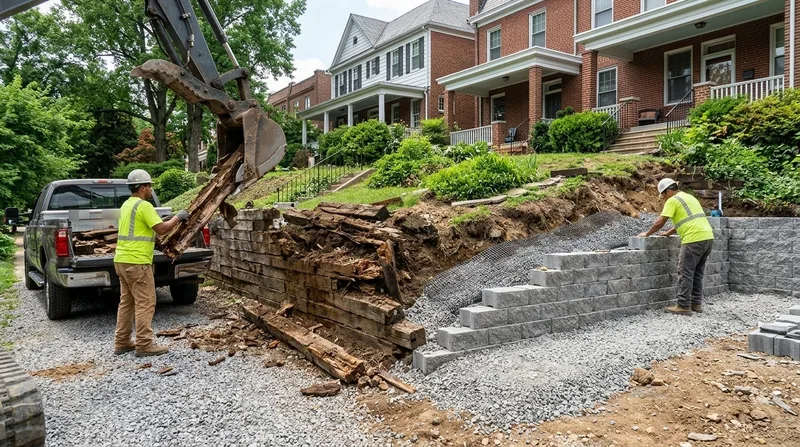




Retaining Wall Replacement in Washington is a critical investment when your existing wall has reached the end of its life. Washington's unique geography, split between the hard-rock terrain of the northwest (Rock Creek Park, Georgetown, the Palisades) and the soft coastal-plain clay of Capitol Hill, the Navy Yard, and the riverside flats, creates distinct wall failure patterns. East of the Anacostia River, steep wooded hillsides of slippery clay compound the problem. The city's historic rowhouses with sunken areaways, Wardman porch rows, and postwar garden apartments all depend on retaining walls to hold back soil and manage water. When freeze-thaw cycles, frost heave, saturated clay after summer cloudbursts, and the region's high water table damage your wall, replacement is often the only lasting solution. We remove failed walls completely, haul away debris, install modern drainage, and rebuild with engineered materials designed to survive Washington's climate for decades. If your wall is still salvageable, retaining wall repair may be an option, but many older walls need full replacement.
Why Retaining Wall Replacement Matters in Washington's Challenging Soil and Climate
Washington sits on two very different geologies. The northwest quadrant rests on bedrock and rocky terrain; the southeast and eastern neighborhoods sit on soft clay that absorbs water like a sponge. After heavy rain or during winter freeze-thaw cycles, this clay expands and shifts, pushing against retaining walls with tremendous force. Gray fieldstone walls with old mortar, brick structures, and landscape timber or railroad tie walls fail first because they cannot withstand this pressure. Poured concrete and CMU blocks last longer, but even they crack and lean when drainage fails or the soil behind them becomes saturated. Modern segmental block systems with proper drainage, compacted backfill, and engineered design survive Washington's weather and soil movement far better than the walls they replace.
- We demolish and haul away the entire failed wall structure, including rotted timber and deteriorated mortar.
- We install a drainage system behind the new wall to manage the high water table and seasonal saturation that dominates Washington's clay soils.
- We build with modern materials, engineered to handle freeze-thaw stress and the weight of wet, heavy clay common east of the Anacostia.
- We ensure setbacks and property-line compliance; many Washington jurisdictions require a permit for walls above roughly 4 feet or when a wall supports a driveway or structure.
A complete replacement eliminates the risk of sudden failure and gives you a wall that will perform reliably for 30 to 50 years.
Key info: Washington's freeze-thaw cycle and clay soil saturation cause more retaining wall failures than any other factor. A wall that stood for 20 years may suddenly lean or buckle after a wet winter or a series of heavy rains. Once a wall has failed, repair is temporary; replacement is permanent.
For detailed guidance on what happens to walls in this climate, consult the District of Columbia Department of Energy and Environment stormwater and erosion control guidelines, which outline soil and drainage requirements for construction in the District.
How We Execute Retaining Wall Replacement in Washington: Our Process
Replacement is a systematic demolition and rebuild. We start with a site visit to assess the failed wall, the soil behind it, and the drainage situation. We then remove the old structure completely, haul away all debris, and prepare the foundation. We install a new drainage system, compacted backfill, and a new wall built to modern standards and local code. The entire process takes 1 to 3 weeks depending on wall size and complexity. For a Georgetown rowhouse with a sunken front areaway and a failing gray fieldstone wall, we remove the old wall, install a modern block system with drainage, and integrate it with the existing architecture so it looks intentional, not patched.
- We obtain any required permits from the local building department before work begins.
- We demolish the existing wall and remove all material from the site.
- We excavate and prepare a stable footing, accounting for Washington's clay and water table.
- We install perforated drainage pipe and gravel backfill to manage water behind the new wall.
- We build the new wall with segmental block, poured concrete, or natural stone, depending on your site and budget.
- We compact and finish the soil, ensure proper grading to shed water away from the wall, and clean up completely.
Every step is designed to eliminate the conditions that failed your old wall.
Example: A Congress Heights home had a 30-year-old landscape timber wall collapsing under the weight of wet clay. We removed the rotted timber, installed a segmental block wall with a full drainage system, and graded the yard to direct water away from the base. The new wall has stood through two winters of heavy rain and freeze-thaw cycles without movement.
To learn more about how proper retaining wall drainage prevents future failure, see our drainage service page.
Retaining Wall Replacement Methods and Materials
| Approach | Description | Best for |
|---|---|---|
| Segmental Block (SRW) | Interlocking engineered blocks, stackable without mortar, with internal drainage and geogrid reinforcement for tall or high-load walls. | Most Washington applications; handles clay saturation and freeze-thaw; lasts 40+ years with proper drainage. |
| Poured Concrete | Solid cast-in-place reinforced concrete wall, monolithic and very strong, with integral drainage and waterproofing on the back face. | High-load applications, tall walls, or where a solid appearance is required; common in Navy Yard and Capitol Hill rowhouse areas. |
| Boulder and Natural Stone | Large fieldstone or boulders set in a stable gravel matrix, with gravel backfill and drainage; rustic appearance that blends with Georgetown and Palisades neighborhoods. | Aesthetic preference; works well on lower walls or where a natural look complements the home; less suitable for very tall or high-load walls. |
| Timber or Composite | Pressure-treated wood or composite beams stacked and tied back with deadmen or cables, with gravel backfill and drainage; shorter lifespan than block or concrete. | Lower walls, temporary solutions, or when budget is tight; not recommended for Washington clay and high water table due to rot and heave risk. |
The choice depends on wall height, soil load, drainage conditions, and your aesthetic preference. Most Washington homes benefit from segmental block or poured concrete because both handle the region's clay, water saturation, and freeze-thaw stress.
Retaining Wall Replacement Cost in Washington: What to Expect
Pricing for retaining wall replacement in Washington starts at approximately $35 per square foot for a basic segmental block wall in good access conditions. A 50-foot wall, 4 feet tall, runs roughly 200 square feet and costs $7,000 to $10,000 installed with standard drainage. Factors that increase cost include wall height, soil conditions (clay and saturation add complexity), access difficulty (steep lots or tight spaces), proximity to structures or utilities, and material choice. Poured concrete runs higher than segmental block; natural stone higher still. A wall that requires engineered drawings, deep footings, or extensive drainage work may exceed $50 per square foot. We recommend getting 2 to 3 estimates from licensed contractors so you can compare scope, materials, and timeline. See our full pricing overview for more detail on what drives costs up or down.
Never choose a contractor based on price alone. A cheap estimate often means corners cut on drainage, compaction, or material quality. In Washington's climate, a poorly built replacement wall will fail again within 5 to 10 years. Spend the money upfront on a properly engineered and built wall, and you will not need replacement again for 30+ years.
What to Look for When Hiring a Retaining Wall Contractor Near Me in Washington
Choose a contractor who is licensed, insured, and experienced with Washington's specific soil and climate challenges. Ask for references from homes in your neighborhood, Georgetown, Capitol Hill, Congress Heights, or Hillcrest so you can see how their walls have performed through multiple winters. Verify that the contractor understands local permit requirements. Many Washington jurisdictions require a permit for walls above roughly 4 feet or when a wall supports a structure; thresholds vary by zone, so always confirm with your local building department before work starts. If your home is in a historic district or subject to HOA rules, ask whether those rules require approval of wall materials or design. Get the estimate in writing, including materials, labor, drainage scope, and timeline. Ask whether the contractor guarantees the work and for how long. A reputable contractor stands behind their replacement wall for at least 5 years.
- Verify the contractor holds a current Washington or Maryland contractor license and carries liability and workers' compensation insurance.
- Request at least three references from similar jobs in Washington completed within the last 2 to 3 years.
- Confirm the contractor will obtain all required permits and handle interactions with the building department.
- Ask whether the quote includes a drainage system, compacted backfill, and grading to manage water behind the wall.
- Ensure the contractor can explain why your old wall failed and how the new design prevents that failure mode.
- Get a written warranty or guarantee on materials and workmanship, and clarify how long it covers.
A professional contractor will welcome these questions and provide clear, detailed answers. Contact us for a free estimate and we will walk you through the entire process and answer every concern you have.
Retaining Wall Replacement in Washington: Pricing Guide
| Service | Price | Details |
|---|---|---|
| Segmental Block Wall Replacement | Starting at $35/sq ft | Standard engineered segmental block with drainage and compacted backfill; price varies with wall height, soil complexity, and access difficulty on your Washington lot |
| Poured Concrete Wall Replacement | Starting at $45/sq ft | Reinforced cast-in-place concrete with integral drainage and waterproofing; higher cost reflects material and labor for formwork and curing in Washington's humid climate |
| Natural Stone or Boulder Wall Replacement | Starting at $50/sq ft | Large fieldstone or boulders set in gravel matrix with full drainage system; price depends on stone availability, size, and complexity of the site |
| Complex or Large-Scale Replacement | On estimate | Tall walls, engineered design, deep footings, or extensive site prep require an on-site assessment and engineer review before a firm price can be quoted |
| Permit and Design | Included or separate | Simple walls under 4 feet may not require a permit; taller walls or those supporting a structure typically need permit and may need engineered drawings, cost varies by jurisdiction |
| Free Estimate | Free | We provide a detailed no-obligation site visit and written estimate within 24 hours; call (771) 252-1406 to schedule |
Indicative pricing, the exact cost depends on square footage, finish, and site access. Free personalized estimate within 24h at (771) 252-1406.


