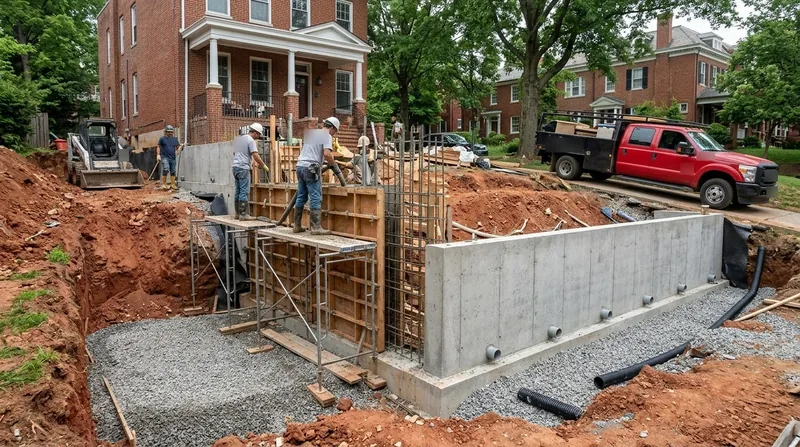




Concrete retaining walls in Washington are the most durable solution for the region's challenging terrain, freeze-thaw cycles, and aging rowhouse lots. Washington's geography splits sharply: the northwest rises on hard rock and ravines around Rock Creek Park and the Palisades, while Capitol Hill and the riverside flats rest on soft coastal-plain sand, silt, and clay. East of the Anacostia River, steep wooded hillsides of slippery clay demand walls that hold firm through saturated soil, tropical-storm rain, and a high water table. Federal and Victorian brick rowhouses with sunken areaways, Wardman porch rows, and postwar garden apartments all depend on retaining walls to manage slope and drainage. Poured concrete and reinforced CMU block walls are the strongest option for tall installations, alley driveways, and tight lots where failure is not an option. We install, repair, and replace concrete retaining walls with frost-depth footings, rebar, and weep holes engineered to handle Washington's soil and climate.
Why Concrete Retaining Walls Matter in Washington's Unstable Soils
Washington's soft, saturated clay and silt are not forgiving. Freeze-thaw cycles crack mortar and push fieldstone walls outward. Summer cloudbursts and tropical storms saturate the ground, increasing hydrostatic pressure behind any wall. A leaning or collapsed retaining wall is not cosmetic damage, it is a structural failure that threatens foundations, driveways, and neighboring property. Concrete and reinforced block walls resist this pressure because they are monolithic, properly drained, and anchored below the frost line (typically 3.5 feet in Washington). Older brick, timber, and stone walls fail first because they lack modern drainage and frost protection.
- We install concrete walls with weep holes and perforated drain tile to shed water before it builds pressure behind the wall.
- We set footings below the frost line to prevent frost heave from lifting or tilting the wall.
- We use reinforcing rebar and proper concrete mix to create a monolithic structure that resists bending and cracking.
- We design walls to match local building code and setback rules, which vary by jurisdiction in Washington.
- We repair existing concrete walls that are cracked, leaning, or failing, often without full replacement.
These measures add cost upfront but prevent catastrophic failure and expensive emergency repairs later.
Key info: The Washington DC Department of Energy and Environment (DOEE) and your local building department set rules for wall height, setbacks, and drainage. Walls over roughly 4 feet or supporting a surcharge (driveway, deck, structure) typically require a permit and may need engineered drawings. Always check with your local building department before starting work. Visit DOEE.dc.gov or your city or county permit office for specific thresholds.
How We Install and Repair Concrete Retaining Walls in Washington
Our process starts with a site visit to assess soil type, drainage, frost depth, and proximity to structures. We determine whether you need a new wall, a repair to an existing wall, or a full replacement of a failed timber or block wall. We then obtain or help you obtain the necessary permits, provide engineered drawings if required, and schedule the work around weather and site access. We excavate, set frost-depth footings, install rebar and forms, pour or lay reinforced concrete or CMU, backfill with gravel and perforated drain tile, and finish with proper grading and drainage. The result is a wall that will hold for 40, 50, or more years.
- We conduct a free site evaluation and discuss your soil conditions, wall height, and local permit requirements.
- We provide a detailed estimate that includes materials, labor, permits, and timeline so you know exactly what to expect.
- We obtain or coordinate permits with your local building department to ensure compliance with Washington setback and height rules.
- We excavate and set footings below the frost line (typically 3.5 feet), with gravel base and proper compaction.
- We install rebar grid and build forms or lay reinforced CMU block to the specified height and batter (slight backward lean).
- We pour concrete or complete block work, then backfill with drainage gravel and perforated drain tile behind the wall.
- We finish with proper grading so water sheds away and weep holes remain clear for drainage.
From start to finish, we manage permits, site safety, and cleanup so you can focus on your property.
Example: A rowhouse in Capitol Hill has a sunken front areaway with a 6-foot fieldstone wall that is leaning inward and cracking mortar. We remove the old wall, set a new frost-depth footing, pour a reinforced concrete wall with weep holes, and backfill with drain tile. The new wall is vertical, durable, and designed to handle the clay soil and high water table common to that neighborhood. We pull the required permit from the DC Department of Buildings and complete the work in 2 to 3 weeks.
For more information on how we approach retaining wall repair and replacement of failed walls, contact us for a free estimate.
Concrete Retaining Wall Methods and Materials
| Approach | Description | Best for |
|---|---|---|
| Poured Concrete | Monolithic reinforced concrete wall set below frost line with weep holes and drain tile. Custom height and thickness, excellent strength. | Tall walls (6+ ft), tight alley lots, high water table, maximum durability and minimal maintenance. |
| Reinforced CMU Block | Concrete masonry unit (CMU) block laid with rebar and grout, set on frost-depth footing. Faster than poured concrete, still very strong. | Medium to tall walls (4-8 ft), moderate budgets, good drainage capability, visible block finish or painted. |
| Concrete Wall Repair | Epoxy injection, rebar addition, or partial rebuilding of existing poured concrete walls that are cracked or leaning but not fully failed. | Existing concrete walls with minor to moderate damage, cost savings vs. full replacement, same longevity if done properly. |
| Drainage and Backfill | Perforated drain tile, gravel backfill, and weep holes integrated into all concrete walls to manage groundwater and prevent hydrostatic pressure. | All concrete retaining walls in Washington, especially in clay soil with high water table and seasonal saturation. |
Concrete Retaining Walls Cost in Washington: What to Expect
Concrete retaining wall costs in Washington typically start at $35 per square foot for basic poured concrete or reinforced CMU installations on accessible sites with stable soil. A 30-foot-long wall, 5 feet tall, is roughly 150 square feet, so you might expect $5,250 to $7,500 before permits and site-specific factors. Taller walls, difficult access, poor soil requiring extra excavation, proximity to structures, or the need for engineered drawings will increase the price. Repair of an existing concrete wall costs less, often $20 to $30 per linear foot, depending on the extent of damage and whether the footing is sound. Replacement of a failed timber or block wall costs more because we must remove the old structure and properly dispose of materials.
Several factors move the estimate up or down. Wall height and length are the primary drivers, height more than length. Soil conditions matter: soft clay requires deeper footings and more careful excavation than firm, well-drained soil. Access and site layout affect labor: a tight alley lot or a property surrounded by landscaping or structures costs more to work in. Drainage and water table may require extra gravel, perforated tile, or a sump pump system, adding cost. Permits and engineering add fees if your wall requires drawings or city review. Always get 2 or 3 estimates from licensed contractors so you can compare scope, materials, and timeline. A low estimate that skips proper footings or drainage is a red flag.
For detailed pricing and a breakdown of what affects your specific project, visit our pricing page or call us at (771) 252-1406 for a free estimate.
Concrete Retaining Walls Near Me: What Washington Homeowners Should Know When Hiring a Contractor
Hiring the right contractor for a concrete retaining wall is not just about price. Your wall is a structural element that will affect your property for decades, so verify credentials, check references, and understand permits before you sign. A licensed and insured contractor carries liability coverage and workers compensation, protecting you if someone is injured on your property. Ask to see proof of licensing and insurance, and confirm that your contractor is familiar with Washington building codes and soil conditions. Many homeowners in Washington assume a wall does not need a permit, but walls over 4 feet or supporting a surcharge typically do. Your contractor should know this and help you navigate the permit process rather than skip it.
- Confirm your contractor is licensed by the DC Department of Consumer and Regulatory Affairs (DCRA) or your local licensing board, and carries current liability and workers compensation insurance.
- Ask for references from recent concrete retaining wall jobs in Washington, and call or visit those sites to see finished work and talk to homeowners.
- Get written estimates from at least 2 contractors, including scope, materials, timeline, permits, and price, so you can compare apples to apples.
- Verify permit requirements with your local building department before work begins, and confirm your contractor will obtain or coordinate permits.
- Check for HOA restrictions or easements on your property that might affect wall placement or height, and discuss these with your contractor upfront.
- Ask how the contractor will handle drainage, frost depth, and backfill, since these are where quality separates good work from poor work.
A reputable contractor will answer these questions clearly and provide a detailed estimate and timeline. If a contractor rushes you, avoids the permit question, or cannot provide references, keep looking.
Ready to get started? Contact us for a free, no-obligation estimate. We will visit your site, assess the work, discuss permits and options, and provide a clear price and timeline. You can also call (771) 252-1406 to speak with our team directly.
Concrete Retaining Walls in Washington: Pricing Guide
| Service | Price | Details |
|---|---|---|
| Poured Concrete Wall | Starting at $35/sq ft | Frost-depth footing, reinforced concrete, weep holes, drain tile, basic backfill and grading included |
| Reinforced CMU Block Wall | Starting at $30/sq ft | Concrete block, rebar, grout, frost-depth footing, drain tile, weep holes, faster installation than poured concrete |
| Concrete Wall Repair | Starting at $20/linear ft | Epoxy injection, crack sealing, rebar addition, or partial rebuilding of existing concrete walls without full replacement |
| Difficult access or poor soil | On estimate | Alley lots, tight spaces, saturated clay, high water table, or proximity to structures require site visit and custom pricing |
| Permits and engineering | Additional cost | Walls over 4 feet or supporting surcharge may require permit and engineered drawings from your local building department |
| Free estimate | No obligation | We visit your site, assess soil and slope, discuss options, and provide a detailed written estimate within 24 hours |
Indicative pricing, the exact cost depends on square footage, finish, and site access. Free personalized estimate within 24h at (771) 252-1406.


