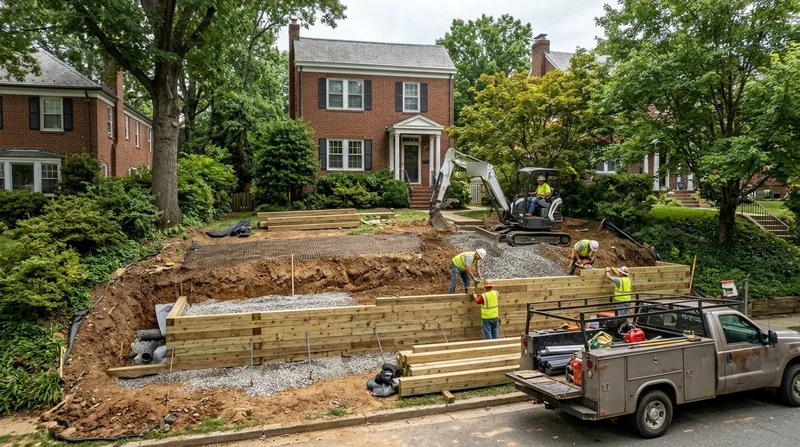




Timber retaining walls in Washington serve as a budget-friendly solution for garden beds, low terraces, and slope control across the District's diverse neighborhoods, from the rocky ravines of Georgetown and the Palisades to the steep clay hillsides of Congress Heights and Fort Dupont. Pressure-treated timber walls work best for modest heights and non-structural applications, but Washington's climate, freeze-thaw cycles, and saturated clay soils demand honest guidance on when timber makes sense and when a longer-lasting material like concrete block or stone will protect your investment. Our team installs, repairs, and replaces timber walls with an eye toward realistic lifespan, proper drainage, and compliance with local building codes. Whether you're terracing a Wardman porch garden or stabilizing a sunken areaway, we help you choose the right material for your site and budget.
Why Timber Retaining Walls Matter in Washington's Variable Terrain
Washington splits along the Fall Line, creating two very different wall environments. The northwestern ridge around Rock Creek Park and Georgetown rises on hard rock and rocky outcrops, where timber walls anchor garden beds against stable ground. The southern and eastern slopes, from Capitol Hill to the Anacostia River corridor, sit on soft coastal-plain clay and silt that swells when wet and shrinks when dry. This clay, combined with our humid subtropical summers and freeze-thaw winters, places enormous pressure on timber walls. Water infiltration, frost heave, and root growth compromise untreated or partially treated wood within 7 to 12 years. Pressure-treated timber extends that lifespan to 15 to 20 years if drainage is properly managed, but it remains a temporary solution in high-moisture zones.
- Timber walls absorb moisture in Washington's clay-rich, humid climate and fail faster than in drier regions.
- Freeze-thaw cycles in winter cause frost heave that lifts and cracks timber walls, especially those without proper base preparation.
- Saturation after summer cloudbursts and tropical-storm rain destabilizes the soil behind the wall, pushing timber boards outward and inward.
- Proper drainage behind a timber wall is non-negotiable in Washington and adds to the initial cost but extends service life.
- Timber walls work well for terracing garden beds and low slopes but should not support heavy surcharges like driveways or structures.
Understanding these local failure modes helps you invest wisely in the right wall type for your property.
Key info: Washington's clay soils and high water table near the Anacostia River and other low-lying areas demand excellent drainage behind any timber wall. Without a perforated drain pipe and gravel backfill, even pressure-treated timber will rot within a decade. Always budget for proper drainage installation, not just the boards themselves.
For more on how soil and water affect retaining walls, see our guide to retaining wall drainage in Washington.
The District of Columbia Department of Energy and Environment (DOEE) and local building departments in Arlington, Alexandria, and other jurisdictions provide guidance on wall permits and setback requirements. Check your local code before purchasing materials, as walls above 4 feet or those supporting a surcharge typically require a permit and may require engineered drawings.
How We Install and Repair Timber Retaining Walls in Washington
Proper installation separates a timber wall that lasts 20 years from one that fails in 5. We begin with site assessment, checking soil type, drainage patterns, and load conditions. On Washington's clay slopes, we excavate a level footing at least 12 inches below grade, compact the base, and install a gravel bed to promote drainage. We then set pressure-treated posts (typically 6x6 or 4x12 lumber) vertically or slightly battered (angled back), secure them with galvanized hardware, and backfill with a gravel-and-drain-pipe system. Proper slope and perforated drain tile direct water away from the soil behind the wall, preventing saturation and frost heave.
- We assess your site's soil type, water table, and slope angle to determine if timber is the best choice or if concrete, block, or stone is more durable.
- We excavate a stable footing below the frost line and compact the base to prevent settling and tilting.
- We install pressure-treated posts with galvanized lag bolts and hardware rated for ground contact, ensuring connections resist rust and rot.
- We run a perforated drain pipe behind the wall and backfill with clean gravel to direct water away from the soil and timber.
- We check alignment and batter (backward lean) throughout installation to ensure the wall sheds water and resists outward pressure.
- We cut and install timber boards (4x12 or 6x8 typical) horizontally between posts, leaving small gaps for drainage and wood movement.
Repair work on existing timber walls in Washington often involves replacing rotted boards, resetting tilted posts, or installing new drainage when old walls are failing. Learn more about retaining wall repair in Washington.
Local example: A Federal-era rowhouse in Capitol Hill with a sunken front areaway had a timber wall that was bowing inward after 12 years. We removed the deteriorated boards, installed new pressure-treated 6x12 timbers on existing posts, added a perforated drain line with gravel backfill, and sealed the top with landscape fabric. The wall now sheds water properly and will serve another 15 to 20 years with routine inspection.
Timber Retaining Wall Installation Methods and Materials
| Approach | Description | Best for |
|---|---|---|
| Pressure-Treated Post and Board | Vertical 6x6 posts set below frost line, with 4x12 or 6x8 horizontal boards bolted between posts. Standard gauge for residential timber walls across Washington. | Garden terraces, low slopes, non-structural applications, heights up to 4 feet. |
| Tiered or Stepped Walls | Multiple short timber walls stacked with a level bench between each tier. Reduces pressure on any single wall and improves drainage on steep slopes. | Steep wooded hillsides in Congress Heights or Fort Dupont where a single tall wall would fail. |
| Timber with Geotextile Reinforcement | Landscape fabric or geogrid installed behind horizontal boards to distribute soil load and reduce outward pressure. Adds cost but extends life on clay slopes. | Medium-height walls (3 to 5 feet) on saturated clay soils near the Anacostia River or low-lying neighborhoods. |
| Railroad Tie Replacement with Pressure-Treated Timber | Removal of old, creosote-treated railroad ties and installation of modern pressure-treated lumber with proper drainage and hardware. Safer and longer-lasting than old ties. | Existing walls in older Washington neighborhoods that need repair or replacement. See our railroad tie wall replacement service. |
Timber Retaining Walls Cost in Washington: What to Expect
Timber retaining wall costs in Washington typically start at $20 per square foot for straightforward installations with good access and stable soil. A 4-foot-tall, 20-foot-long wall on level ground with proper drainage can run $1,600 to $2,400 depending on lumber grade, hardware, and site conditions. However, several factors push costs higher. Difficult access (narrow alleys in rowhouse neighborhoods, steep slopes, proximity to structures), clay soil requiring deeper footings, high water tables, and the need for engineered drawings on tall or tiered walls all increase the price. A complex job on a Fort Dupont hillside with poor access and high groundwater may run $35 to $45 per square foot or more.
When comparing estimates, ask each contractor what is included: the footing depth, post spacing, hardware, drainage pipe, gravel backfill, and site cleanup. A low bid that skips drainage or uses shallow footings will fail early. Get 2 to 3 estimates and ask for references from similar jobs in Washington neighborhoods. Visit our pricing page for a detailed breakdown by wall type and height.
Labor typically accounts for 50 to 60 percent of the cost on timber walls, especially when drainage, post setting, and board installation are done correctly. Materials, including pressure-treated lumber and galvanized hardware, make up the rest. Travel and equipment are included in our estimates for Washington and surrounding areas, with no separate mileage fee.
What to Look for When Hiring a Retaining Wall Contractor Near Me in Washington
Choosing the right contractor ensures your timber wall is built to last and complies with local code. Start by verifying that the contractor is licensed and insured in Washington, DC or your jurisdiction (Arlington, Alexandria, and other surrounding areas each have their own licensing requirements). Ask for proof of liability insurance and a current business license. A reputable contractor will provide references from recent jobs in your neighborhood and can show photos of completed walls that have weathered a full season or more.
Request 2 to 3 detailed estimates that specify footing depth, post spacing, lumber grade, hardware, drainage system, and site cleanup. If your wall requires a permit (typically walls above 4 feet or those supporting a surcharge), the contractor should help you understand the application process and timeline. Ask about any HOA restrictions or covenants that may apply to wall height, material, or setback from property lines. Confirm that the contractor will obtain necessary permits before work begins, not after.
Finally, discuss maintenance. Timber walls need routine inspection every 2 to 3 years, especially in Washington's wet climate. Check for wood rot, loose boards, and drainage blockage. A contractor who offers post-installation inspections and minor repairs shows commitment to long-term performance. Ready to get started? Contact us for a free estimate at (771) 252-1406, and we will respond within 24 hours.
Timber Retaining Walls in Washington: Pricing Guide
| Service | Price | Details |
|---|---|---|
| Timber wall, 3-4 feet tall, good access | Starting at $20/sq ft | Pressure-treated posts and boards, standard footing, gravel backfill, no engineered drawings required |
| Timber wall, 4-5 feet tall, or difficult access | Starting at $28/sq ft | Deeper footings on clay, tiered installation, or narrow alley access in rowhouse neighborhoods adds labor |
| Timber wall with geotextile reinforcement or high water table | Starting at $32/sq ft | Geogrid or landscape fabric, enhanced drainage, perforated drain pipe, gravel backfill on saturated soil |
| Tall, tiered, or engineered timber wall | On estimate | Walls above 5 feet, tiered systems, walls supporting surcharges, or sites with poor soil require site visit and drawings |
| Estimate and site visit | Free | No obligation, response within 24 hours at (771) 252-1406 for Washington and surrounding areas |
Indicative pricing, the exact cost depends on square footage, finish, and site access. Free personalized estimate within 24h at (771) 252-1406.


