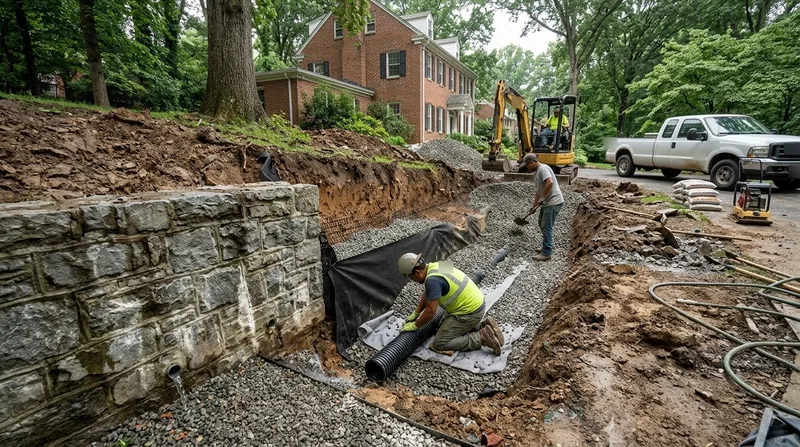




Washington's retaining walls face a relentless enemy: water. The city's geography splits along the Fall Line, with the northwest rising on hard rock around Rock Creek Park and Georgetown, while Capitol Hill, Navy Yard, and the riverside flats sit on soft coastal-plain sand, silt, and clay. East of the Anacostia River, steep wooded hillsides of slippery clay climb toward Hillcrest, Congress Heights, and Fort Dupont. The result is predictable: after summer cloudbursts and tropical-storm rain, hydrostatic pressure builds behind fieldstone, brick, poured concrete, CMU, segmental block, and tired landscape timbers. Retaining wall drainage in Washington is not optional. It is the difference between a wall that stands for decades and one that leans, cracks, and fails. We install French drains, weep holes, gravel backfill, and waterproofing systems that relieve that pressure before it destroys your wall. This guide explains why drainage matters in Washington, how we design and build it, and what to expect when you call.
Why Retaining Wall Drainage Fails in Washington's Clay and High Water Table
Washington's soil and climate conspire against walls. The coastal-plain clay that dominates the eastern and southern portions of the city holds water like a sponge. When rain falls, it does not drain away quickly. The water table near the Anacostia and Potomac rivers sits high year-round. Freeze-thaw cycles in winter force moisture into cracks, expand it, and push walls outward. Summer tropical storms dump inches of rain in hours, saturating clay and creating hydrostatic pressure that acts like a hydraulic press against your wall. Without a drainage system to relieve that pressure, the wall will move, lean, crack, or fail catastrophically.
- Water trapped behind a wall creates lateral pressure that pushes the wall away from the soil.
- Clay soil in Washington holds moisture far longer than sandy or rocky soil, compounding the pressure problem.
- Freeze-thaw cycles in winter exploit existing cracks and accelerate failure of mortar and concrete.
- Tropical storms and heavy spring rains saturate the high water table, increasing subsurface flow and pressure.
- Walls without drainage fail 3 to 5 times faster than walls with proper systems in place.
Drainage is the single most important factor in wall longevity in Washington. Without it, even a well-built wall will eventually fail.
Local reality: A fieldstone wall in Georgetown built in 1920 without drainage began leaning inward in 2015 after a series of wet winters. A new French drain system and gravel backfill stopped the movement and saved the wall. The same wall without drainage would have required full replacement by 2018.
For more on wall failure and repair, see our guide to leaning and collapsed wall repair in Washington.
Washington's building codes recognize this risk. The District of Columbia building department and jurisdictions in surrounding areas require proper drainage for any retaining wall, and engineered drainage systems are often mandated for walls taller than 4 feet or supporting a surcharge such as a driveway or structure. Always verify the specific threshold with your local building department before design or construction.
How We Design and Install Retaining Wall Drainage in Washington
Our drainage strategy is simple and field-proven: move water away from the wall as fast as possible, and relieve pressure before it builds. We start with a site assessment to understand the soil type, water table depth, and seasonal flow patterns. Then we design a system tailored to your wall's height, material, and the specific clay or silt conditions on your property. The system typically includes a perforated drain pipe, gravel backfill, geotextile fabric, and weep holes spaced along the wall face.
- We excavate behind the wall to expose the full height of the structure and assess existing conditions.
- We install a perforated drain pipe (typically 4-inch PVC or HDPE) at the base, sloped to daylight or a sump.
- We backfill with clean gravel (not clay or silt) to allow water to flow freely toward the drain pipe.
- We place geotextile fabric over the gravel to prevent soil from clogging the drainage layer.
- We drill weep holes through the wall face (typically 2-inch diameter, spaced 4 to 6 feet apart) to allow standing water to escape.
- We slope the ground surface away from the wall to shed surface water and reduce infiltration.
The result is a wall that breathes. Water moves through the gravel, out through the drain pipe and weep holes, and away from the structure. Pressure never builds. The wall stands stable for decades.
Real example: A 1950s colonial home in Capitol Hill had a 6-foot poured concrete retaining wall supporting a back patio. After two wet winters, the wall cracked and began to bow inward. We excavated, installed a 4-inch perforated drain pipe at the base with 6 feet of clean gravel backfill, added geotextile, and drilled four 2-inch weep holes along the face. The wall stabilized within weeks. No more water pooling behind it, no more new cracks.
For details on retaining wall repair in Washington, including drainage retrofits for existing walls, contact us for a free assessment.
Retaining Wall Drainage Methods and Materials
| Approach | Description | Best For |
|---|---|---|
| French Drain System | Perforated drain pipe at wall base, surrounded by clean gravel and geotextile fabric, sloped to daylight or sump. | All wall types in Washington, especially clay and high water table areas. The most cost-effective and durable solution. |
| Weep Holes | 2-inch to 3-inch diameter holes drilled or cast through the wall face, spaced 4 to 6 feet apart vertically and horizontally. | Retrofit work on existing walls, concrete and CMU walls, and situations where full excavation is difficult. |
| Gravel Backfill | Clean 3/4-inch to 1-inch gravel (no clay, silt, or fines) placed between the wall and native soil, minimum 2 feet deep. | New wall construction and major repairs. Works in tandem with drain pipe and weep holes. |
| Geotextile Fabric | Permeable, non-woven fabric placed over gravel to prevent soil migration while allowing water flow. | All drainage systems. Extends the life of gravel backfill and drain pipe by preventing clogging. |
| Waterproofing Membrane | Liquid or sheet membrane applied to the wall face or back to block water infiltration and reduce seepage. | Concrete and poured walls in high-moisture areas, or when gravel backfill alone is insufficient. |
| Sump and Pump System | A collecting basin at the base of the wall with a submersible pump that directs water to daylight or storm drains. | Properties where gravity drainage is not possible, or where the water table is very high and volume is large. |
The right combination of these methods depends on your wall's height, material, soil conditions, and the water table on your property. We assess each site individually and recommend the most cost-effective system that will last.
Retaining Wall Drainage Cost in Washington: What to Expect
Drainage retrofits for existing walls typically start at $2,500 for a modest system on a smaller wall. New wall construction with integrated drainage starts higher because the wall itself is part of the cost. The price depends on several concrete factors: the length of the wall, its height, the type of soil and water table on your property, access for excavation, and whether the drain can daylight naturally or requires a sump pump.
A French drain system for a 20-foot wall in Capitol Hill with clay soil and moderate water table might run $3,500 to $5,000. A similar system for a 40-foot wall in Congress Heights on a steep slope with heavy clay and a high water table could be $7,000 to $10,000 or more. The difference is not just length, but excavation difficulty, soil conditions, and the volume of water the system must handle.
We always recommend getting two or three estimates before you decide. Call us at (771) 252-1406 for a free, no-obligation site visit. We will examine the wall, assess the soil and water table, and give you a firm price estimate within 24 hours. For a complete pricing overview and typical costs for retaining wall services in Washington, see our pricing guide.
Retaining Wall Drainage Near Me: What Washington Homeowners Should Know When Hiring
Choosing the right contractor for retaining wall drainage is critical. This is not cosmetic work, and poor installation will fail in the next heavy rain. When you call a contractor, ask these questions: Are you licensed and insured in Washington? Can you provide references from recent drainage projects? Do you understand the local soil and water table conditions? Will you pull permits if required by your jurisdiction? Can you explain your drainage design and why you recommend it for your specific property?
Many walls in Washington require a permit for drainage work, especially if the wall itself is taller than 4 feet or if the work involves excavation near property lines. Your local building department will have specific requirements. We handle all permitting and coordinate with the District of Columbia or your jurisdiction's building office. We also understand HOA requirements for homes in managed communities, which often have strict rules about wall modifications.
Get multiple estimates. A contractor who rushes through a site visit and quotes a price over the phone is not taking the work seriously. The best contractors (like us) spend 30 to 45 minutes on site, ask detailed questions about the wall's history and any movement or leaks you have noticed, and assess the soil and water table before giving a number.
For a free estimate and to discuss your wall's drainage needs, contact us today. We serve Washington and surrounding areas, and we are ready to help.
Retaining Wall Drainage in Washington: Pricing Guide
| Service | Price | Details |
|---|---|---|
| French Drain Retrofit (Small to Medium Wall) | Starting at $2,500 | Includes excavation, perforated pipe, gravel backfill, geotextile, and surface grading. Length and soil type affect final cost. |
| French Drain with Weep Holes | Starting at $3,500 | Full French drain system plus drilling or installation of 4 to 6 weep holes through the wall face for faster relief. |
| Waterproofing Membrane and Drainage | Starting at $4,000 | Adds liquid or sheet waterproofing to the wall back or face, reducing infiltration. Ideal for concrete and high-moisture areas. |
| Sump and Pump System | Starting at $5,500 | Required when gravity drainage is not possible or water table is very high. Includes basin, pump, and discharge line to daylight. |
| Large or Complex Drainage Project | On estimate | Multi-tiered walls, very tall walls, or properties with severe water table issues require site assessment before pricing. |
| Free Estimate and Site Visit | Free | No obligation. We visit your property, assess the wall and soil, and provide a detailed quote within 24 hours. |
Indicative pricing, the exact cost depends on square footage, finish, and site access. Free personalized estimate within 24h at (771) 252-1406.


