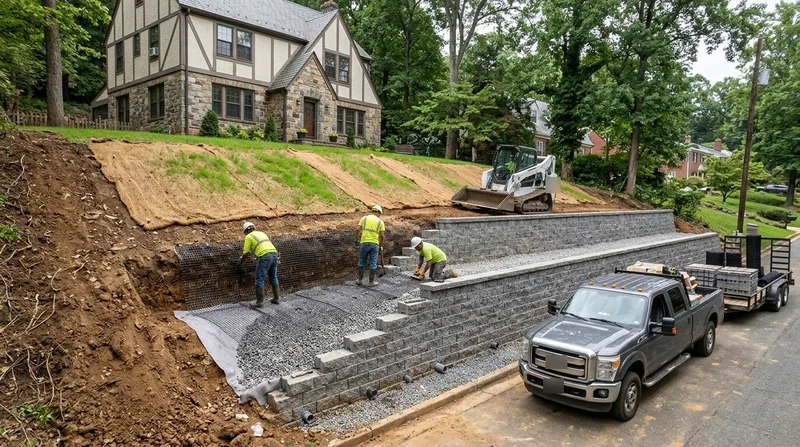




Slope Stabilization & Erosion Control in Washington is not optional on the steep, clay-heavy hillsides east of the Anacostia River and the rocky ravine lots of Northwest. Washington splits along the Fall Line, and the eastern neighborhoods, Hillcrest, Congress Heights, and Fort Dupont sit on slippery clay that moves when saturated. Summer cloudbursts and tropical-storm rain trigger soil creep, gullying, and foundation settlement. The soft coastal-plain soils under Capitol Hill and Navy Yard drain poorly. Freeze-thaw cycles in winter destabilize unbraced slopes and old timber walls. Without proper terracing, geogrid reinforcement, and drainage, hillside yards fail, driveways crack, and homes shift. We stabilize slopes with engineered retaining walls, erosion control fabric, and subsurface drainage so your property stays put.
Why Slope Stabilization Matters in Washington: Clay, Water, and Gravity
Washington's terrain is deceptive. The Federal and Victorian rowhouses with sunken front areaways and the Wardman porch rows sit on hillsides that look stable until they are not. East of the river, postwar garden apartments and Colonial Revival homes perch on steep wooded slopes of clay that holds water like a sponge. When rain falls, that clay saturates, loses cohesion, and creeps downhill. Existing gray fieldstone walls with mortar, old brick structures, poured concrete, and tired landscape timbers fail under the weight and pressure. A single wet season or a series of freeze-thaw cycles can turn a manageable slope into a moving hazard. Proper slope stabilization prevents property damage, protects neighboring structures, and avoids costly emergency repairs.
- Terraced retaining walls distribute soil load and redirect water away from the slope face.
- Geogrid reinforcement anchors soil and increases the shear strength of the slope.
- Subsurface and surface drainage systems prevent saturation and soil creep.
- Erosion control fabric and vegetation stabilize exposed soil and reduce runoff velocity.
- Tiered walls on steep slopes create stable benches and prevent catastrophic failure.
Each of these methods addresses the specific failure modes that dominate in Washington: saturation-driven creep, freeze-thaw heave, and the weight of wet clay pushing against old or undersized walls.
Key info: Washington's building department requires a permit for retaining walls above roughly 4 feet measured from the footing, or when a wall supports a surcharge such as a driveway or structure. Engineered drawings are often required for tall or tiered walls. Always verify setback and property-line rules with your local building department, as thresholds vary by jurisdiction. See DC's building permit requirements for details.
How We Stabilize Slopes in Washington: Assessment to Drainage
Slope stabilization is not one-size-fits-all. We start with a site assessment: we measure slope angle, test soil composition, map existing drainage, identify the water table, and check for signs of active movement, gullying, or saturation. We then design a tiered wall system with proper geogrid reinforcement, calculate footing depth and width to handle the soil load and freeze-thaw cycles, and specify drainage layers and outlet pipes. On steep clay slopes, we often install multiple terraces rather than one tall wall, reducing stress on each level and improving long-term stability. We use segmental block, poured concrete, or stone depending on the aesthetic, budget, and soil conditions. Drainage is built in from the start, not added as an afterthought.
- We conduct a detailed site survey and soil evaluation to understand the slope's composition, water table, and failure history.
- We design a tiered retaining wall system with proper geogrid reinforcement and calculate footing depth for freeze-thaw durability.
- We install subsurface drainage pipe, gravel, and filter fabric behind the wall to manage groundwater and prevent saturation.
- We compact soil in lifts, install geogrid at regular intervals, and backfill with free-draining material.
- We grade the slope surface, install erosion control fabric or vegetation, and establish surface drainage swales to direct runoff away from the wall.
- We verify that all work meets local permit requirements and that the wall is stable before final grading and landscaping.
This methodical approach ensures that the slope stays stable through wet seasons, freeze-thaw cycles, and decades of use.
Example: A Hillcrest homeowner had a steep backyard slope of clay and silt that was moving downhill, cracking the patio and threatening the deck. We installed two terraced block walls with geogrid reinforcement, subsurface drainage, and a swale at the top to intercept runoff. The slope stabilized immediately, the patio cracks stopped spreading, and the deck is now safe. See our retaining wall installation page for more details on how we build these systems.
Slope Stabilization Methods: Tailored Approaches for Washington Terrain
| Approach | Description | Best for |
|---|---|---|
| Terraced Block Walls with Geogrid | Multiple segmental retaining walls stacked with geogrid reinforcement between lifts, subsurface drainage, and compacted backfill. | Steep clay slopes in Hillcrest, Congress Heights, and Fort Dupont where multiple benches reduce wall height and stress. |
| Poured Concrete Tiered Walls | Reinforced concrete walls cast in place with integral drainage, footings below frost line, and proper backfill and compaction. | Properties with high surcharge load, driveway support, or where freeze-thaw durability and minimal maintenance are priorities. |
| Boulder and Natural Stone Walls | Dry-stacked or mortared fieldstone or boulders with geotextile and drainage, often used for aesthetic or heritage reasons. | Georgetown, Palisades, and Northwest properties where the existing gray fieldstone aesthetic must be preserved or matched. |
| Erosion Control with Vegetation | Erosion control fabric, hydraulic seeding, live stakes, and native plantings to stabilize exposed soil and reduce runoff. | Gentle to moderate slopes, slope faces between terraces, and swales where vegetation can reduce maintenance and enhance drainage. |
Each method is chosen based on slope angle, soil type, water table, existing structures, budget, and aesthetic goals. We assess your specific slope and recommend the approach that delivers long-term stability and compliance with Washington's building code.
Slope Stabilization & Erosion Control Cost in Washington: What to Expect
The cost of slope stabilization depends on slope size, soil conditions, wall height and length, geogrid requirements, drainage complexity, and access. A simple one-tier block wall on a small slope may start at a lower price point, while multi-tiered systems with deep footings, extensive drainage, and engineered drawings on steep clay slopes cost significantly more. We provide a free estimate after an on-site assessment. Most homeowners in Washington invest between several thousand and mid-five figures for comprehensive slope stabilization, depending on the scope. Factors that increase cost include deep frost-line footings required for freeze-thaw durability, complex drainage systems for high water tables, geogrid reinforcement for steep angles, and tiered designs for very steep slopes. We recommend getting 2 to 3 estimates so you understand the range and the reasoning behind each bid. See our pricing page for more guidance on what drives cost in your area.
Slope Stabilization & Erosion Control Near Me: What Washington Homeowners Should Know When Hiring
Hiring the right contractor for slope stabilization is critical because a poorly designed or installed wall will fail, often catastrophically. Look for a contractor who is licensed and insured for retaining wall work in Washington, has verifiable experience with slope stabilization on clay soils, and can explain their design reasoning and drainage strategy. Ask for references from recent projects on similar slopes in your neighborhood, Hillcrest, Congress Heights, or Fort Dupont. Verify that the contractor understands Washington's building permit requirements and will obtain necessary approvals before work begins. If your property is in an HOA or historic district, confirm that the contractor is familiar with those restrictions. Always request a written estimate that breaks down labor, materials, drainage, and any engineered drawings. Do not hire based on price alone, especially for slope work, because the cheapest option often means skipped drainage, inadequate geogrid, or shallow footings that will fail in the next wet season or freeze-thaw cycle. Contact us for a free estimate and to discuss your specific slope challenges.
We have stabilized slopes on clay hillsides, rocky ravines, and coastal-plain sites. We handle permits, drainage design, geogrid specification, and long-term durability. Call (771) 252-1406 to discuss your slope or to schedule a free on-site assessment.
Slope Stabilization & Erosion Control in Washington: Pricing Guide
| Service | Price | Details |
|---|---|---|
| Free On-Site Assessment | Free | We evaluate slope angle, soil type, water table, and existing drainage to recommend the right stabilization approach for your property. |
| Single-Tier Block Wall with Drainage | Starting at $4,500 | Segmental retaining wall up to 4 feet tall, geogrid reinforcement, subsurface drainage, and compacted backfill on moderate slopes in Washington. |
| Multi-Tier Slope Stabilization System | Starting at $12,000 | Two or more terraced walls with geogrid, deep footings for freeze-thaw durability, comprehensive drainage, and erosion control on steep clay slopes. |
| Complex or Large-Scale Stabilization | On Estimate | Engineered tiered systems, high water table management, extensive drainage, and special materials require site-specific design and pricing. |
| Travel and Mobilization | Included | No separate call-out or mileage fee for projects in Washington and surrounding service areas within our coverage zone. |
| Estimate Response | Free | We respond within 24 hours with a no-obligation written estimate and design recommendation for your slope stabilization project. |
Indicative pricing, the exact cost depends on square footage, finish, and site access. Free personalized estimate within 24h at (771) 252-1406.


