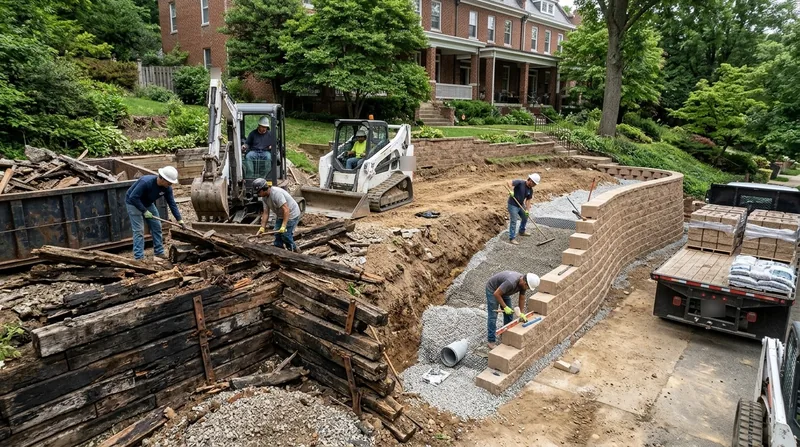




Railroad Tie Wall Replacement in Washington addresses a widespread problem across the District: aging, creosote-treated timber walls from the 1970s and 80s that are rotting, leaning, and failing under the weight of Washington's clay-heavy soil and relentless freeze-thaw cycles. These walls, common in Georgetown, Capitol Hill, the Palisades, and the steep wooded hillsides east of the Anacostia River, absorb water from summer cloudbursts and tropical storms, then crack and heave as winter cold locks moisture in place. When a railroad tie wall fails, it threatens foundations, patios, driveways, and the stability of the slope behind it. We remove the deteriorated ties, haul away the treated wood responsibly, rebuild the drainage system, and install a new retaining wall in segmental block, poured concrete, or natural stone that will outlast the original by decades. This page explains why replacement matters in Washington, how we execute it, what it costs, and what to look for in a contractor.
Why Railroad Tie Wall Replacement Matters in Washington's Freeze-Thaw Climate
Washington's climate and soil are brutal on timber walls. The region straddles the Fall Line: the northwest rises on hard rock and rocky ravines, while Capitol Hill and the riverside flats sit on soft coastal-plain sand, silt, and clay. East of the Anacostia, steep wooded hillsides drain into slippery clay that stays saturated after heavy rain. Freeze-thaw cycles occur 40 to 50 times each winter, pushing and pulling soil, cracking mortar, and splintering creosote-treated ties from the inside out. A failing railroad tie wall does not just look neglected, it becomes a liability.
- Creosote-treated ties leach toxins into soil and groundwater as they decay, and disposal requires licensed hauling.
- Rotted timber loses bearing strength and cannot resist hydrostatic pressure from saturated clay behind it.
- Frost heave pushes the wall outward; water pooling behind it accelerates the lean and collapse risk.
- A collapsed wall can damage a home's foundation, bury utilities, or create a safety hazard on adjacent properties.
- Replacing a failed tie wall before catastrophic failure is far cheaper than emergency repair or damage control.
Prompt replacement protects your property, restores drainage, and eliminates ongoing maintenance headaches.
Key info: Washington homeowners in Wardman porch rows, Federal-era rowhouses with sunken areaways, and 1920s Colonial Revival homes often inherit railroad tie walls that were never designed for modern storm intensity or the region's clay-heavy subsurface. Replacement is common in neighborhoods like Georgetown, Capitol Hill, Navy Yard, and Hillcrest, where slope drainage and wall integrity directly affect foundation health.
For more detail on how walls fail and what repair looks like, see our retaining wall repair page. If your wall is already leaning or showing active movement, read about leaning and collapsed wall repair for emergency options.
Permitting requirements vary by jurisdiction within Washington. Many areas require a permit for walls above roughly 4 feet measured from the footing, or when a wall supports a surcharge such as a driveway. Engineered drawings may be required for tall or tiered walls. Always check with your local building department before starting work. For details on permitting and setback rules, visit the District of Columbia Department of Energy and Environment permit portal.
How We Execute Railroad Tie Wall Replacement in Washington
Our process begins with a full site inspection to assess wall height, soil type, drainage, and any structures or utilities nearby. We then obtain permits if required, mark the work zone, and schedule removal and replacement in a single coordinated effort. The old ties come out first, followed by proper disposal of creosote-treated wood. We install new gravel backfill, set up drainage systems to prevent future saturation, and build the new wall to code and site conditions. Every step is planned to minimize disruption and ensure the new wall performs for 30+ years.
- We inspect the existing wall, soil conditions, and drainage on site to confirm scope and material choice.
- We obtain any required permits and coordinate with your local building department before work begins.
- We remove all deteriorated ties, haul them away as hazardous waste, and clear the site to bare soil.
- We install perforated drain pipe and gravel backfill to channel water away from the new wall.
- We build the new wall in your chosen material (segmental block, poured concrete, or natural stone) to match your home's character and slope requirements.
- We compact and finish the site, and confirm proper drainage and wall alignment before we leave.
The result is a wall that handles Washington's weather, integrates with your landscape, and requires only routine inspection.
Local example: A Palisades homeowner with a 30-foot-long, 4-foot-high railroad tie wall leaning 3 inches outward called us in March. We removed 24 rotted ties, installed a new segmental block wall with proper setback and drainage, and finished in 5 working days. The new wall cost $4,200 and will serve for 30 years without maintenance. The old wall would have collapsed within 2 years.
To learn more about retaining wall installation fundamentals and material options, visit our retaining wall installation page.
Replacement Methods and Materials
| Approach | Description | Best for |
|---|---|---|
| Segmental Block | Interlocking concrete or stone units, no mortar, gravity-set with proper drainage behind. Flexible and durable in freeze-thaw. | Most Washington residential walls, slopes up to 30 feet, moderate to high budgets, modern aesthetic. |
| Poured Concrete | Reinforced concrete stem cast in place, monolithic and very strong, can be finished with stain or facing stone. | High-load applications, very steep slopes, tight spaces, maximum durability, homeowners who want minimal future maintenance. |
| Natural Stone | Fieldstone, granite, or slate laid with mortar or gravity, traditional appearance, blends with historic Washington neighborhoods. | Federal and Victorian rowhouses, Georgetown and Capitol Hill, homeowners prioritizing historic character and curb appeal. |
| Timber (New) | Pressure-treated or naturally rot-resistant wood (cedar, locust), modern timber systems with steel reinforcement, not creosote. | Homeowners who love the rustic look but want 20+ year lifespan, landscapes where timber blends naturally with native plantings. |
Railroad Tie Wall Replacement Cost in Washington: What to Expect
Railroad tie wall replacement in Washington typically starts at $35 per square foot for a basic segmental block rebuild on accessible, level ground with standard drainage. A 30-foot-long, 4-foot-high wall (120 square feet) would run roughly $4,200 to $5,400. However, several factors move the price up or down: wall height, soil conditions, access difficulty, whether the site has utilities nearby, drainage complexity, and your choice of finish material.
A natural stone or poured concrete wall will cost more than segmental block. A very steep slope, limited equipment access (common in Georgetown and the Palisades), or the need for engineered drawings will add cost. Conversely, a short, straight wall on level ground with good drainage already in place may cost less. The best way to know your actual cost is to request a free, no-obligation estimate from us at (771) 252-1406. We assess your site, discuss your preferences, and provide a detailed quote within 24 hours.
For a full pricing overview and examples of cost by wall type and size, visit our pricing page. Getting 2 to 3 estimates from licensed contractors is always smart; it helps you understand the market and spot low-ball bids that cut corners on drainage or material quality.
What to Look for When Hiring a Retaining Wall Contractor Near Washington
Choosing the right contractor for railroad tie wall replacement near Washington is as important as the material itself. A poorly built wall will fail again within 5 to 10 years; a well-built wall will serve for 30+ years. Look for a contractor who is licensed and insured, can show references from recent Washington jobs, understands local permitting and soil conditions, and communicates clearly about cost and timeline. Ask whether they handle drainage design, can work around utilities, and what warranty they offer on labor and materials.
- Verify the contractor holds a current business license and general liability and workers compensation insurance in Washington.
- Request at least three references from homeowners in Washington who had railroad tie walls or similar retaining walls replaced in the past 2 years.
- Confirm the contractor understands local permitting thresholds and has experience obtaining permits for retaining walls in your jurisdiction.
- Ask how the contractor designs drainage, handles saturated clay soils, and prevents frost heave in Washington's freeze-thaw climate.
- Get a detailed written estimate that includes material type, labor, drainage design, haul-away of old ties, and timeline.
- Clarify whether the estimate is free and no-obligation, and how long the contractor guarantees their work.
If your property is in an HOA or a historic district, confirm that the contractor understands any design or approval requirements before work begins.
Ready to move forward? Contact us today at (771) 252-1406 for a free estimate. We serve Washington and surrounding areas, and we can usually schedule an inspection within 48 hours.
Railroad Tie Wall Replacement in Washington: Pricing Guide
| Service | Price | Details |
|---|---|---|
| Segmental Block Wall Replacement | Starting at $35/sq ft | Includes removal of old ties, new gravel and drainage, block installation, and site finish for standard access and height |
| Poured Concrete Wall Replacement | Starting at $45/sq ft | Reinforced concrete stem, formwork, proper drainage, and finishing; higher cost reflects strength and durability in freeze-thaw |
| Natural Stone Wall Replacement | Starting at $50/sq ft | Fieldstone or granite with mortar, traditional appearance, higher material and labor cost for historic Washington neighborhoods |
| Difficult access or steep slope | On estimate | Palisades, Georgetown, and hillside sites often require specialized equipment, hand labor, or engineered design; site visit required |
| Haul-away of creosote-treated ties | Included | Licensed disposal of old railroad ties as hazardous waste is included in the total project cost, no separate charge |
| Free estimate | No charge | On-site inspection, material recommendations, and detailed quote provided within 24 hours at (771) 252-1406 |
Indicative pricing, the exact cost depends on square footage, finish, and site access. Free personalized estimate within 24h at (771) 252-1406.


